Bin Picking
Random bin picking with varying part orientations, materials, and surface finishes. Data includes object 6-DoF poses, gripper approach vectors, grasp success labels, and cycle completion flags.
Manufacturing robotics data
Real-world manufacturing robotics data collected on production floors. Bin picking, assembly, welding inspection, and quality control datasets with calibrated multi-sensor capture for industrial robot training.
Why it matters
Manufacturing is not a generic robotics problem. Every production line has specific part geometries, material properties, cycle-time constraints, and safety requirements. A robot training dataset collected in a lab with toy objects does not transfer to a real assembly station where tolerances are measured in tenths of a millimeter.
Effective manufacturing robotics data must be collected on actual production floors, with real parts, real fixtures, and real environmental conditions. The lighting, vibration, temperature variation, and spatial layout of a factory floor are fundamentally different from a research lab. Models trained on data from these environments generalize to production — models trained elsewhere do not.
Tasks
Random bin picking with varying part orientations, materials, and surface finishes. Data includes object 6-DoF poses, gripper approach vectors, grasp success labels, and cycle completion flags.
Peg-in-hole, snap-fit, screw driving, and multi-step assembly sequences. Data captures contact forces, insertion trajectories, alignment tolerances, and failure modes.
Visual inspection of weld quality, surface defects, dimensional accuracy. Data combines high-resolution imagery with defect annotations and pass/fail classifications.
Loading and unloading CNC machines, press brakes, injection molds. Data captures approach trajectories, part placement accuracy, and cycle integration with machine states.
Layer patterns, box orientations, weight distribution, and stacking sequences. Data includes grasp points, placement coordinates, and pallet configuration labels.
Conveyor picking, tote filling, inter-station transport. Data covers object detection under variable lighting, grasp planning across SKU variation, and placement accuracy.
What gets captured
Every manufacturing data collection session captures synchronized streams: egocentric RGB-D video from the operator's perspective, 6-DoF object and tool poses via motion tracking, joint positions and torques for teleoperation sequences, force-torque profiles at the end effector, and high-resolution inspection imagery.
All streams are timestamped, spatially calibrated, and delivered with full metadata: camera intrinsics, extrinsics, environment descriptions, part catalogs, and fixture specifications. The data is annotated with temporal task segmentation, action labels, object identities, grasp types, and success/failure flags.
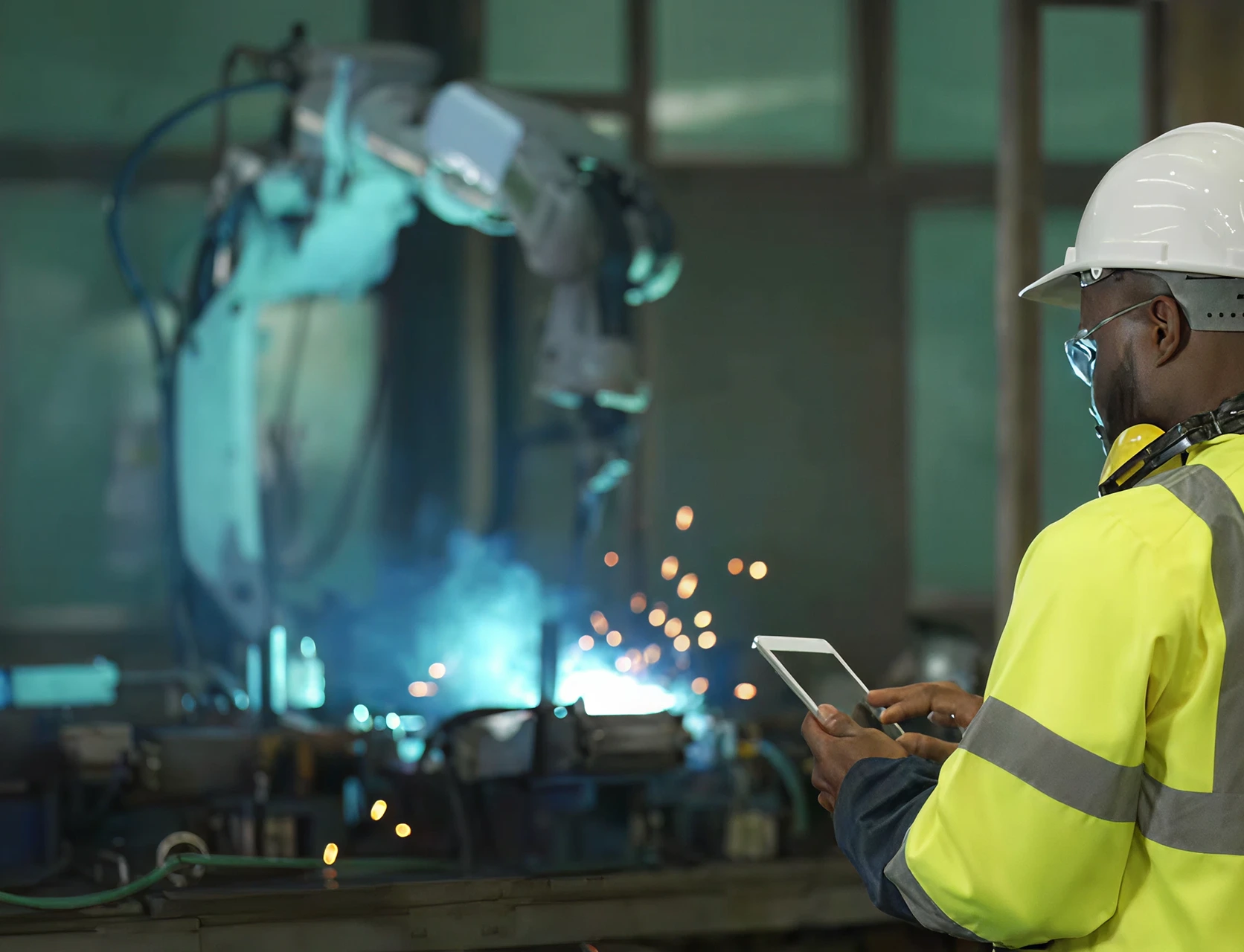 Welding cell · inspection imagery
Pipeline
Humaid handles the full pipeline from protocol design through data delivery. We work with your engineering team to define task specifications, select sensor configurations, and establish quality criteria. Operators are trained on your specific tasks and parts.
Data is collected on your production floor during scheduled sessions. Every episode passes through QC before delivery in your preferred format — ready for behavior cloning, diffusion policy training, or foundation model fine-tuning.
Data Explorer
Every manufacturing dataset collected by Humaid is accessible through the robotics data explorer. Teams can browse assembly sequences, inspect synchronized video with hand-tool interaction overlays, review object detection and action segmentation annotations, and download individual data streams — all before committing to model training.
The explorer currently hosts manufacturing datasets including component assembly, precision fitting, multi-part assembly, and quality inspection — captured on real production floors with egocentric cameras and multi-sensor rigs. Explore manufacturing datasets (opens in a new tab).
Get started
Tell us what your manufacturing robot needs to learn. We will scope the collection, deploy operators to your facility, and deliver production-ready datasets.